
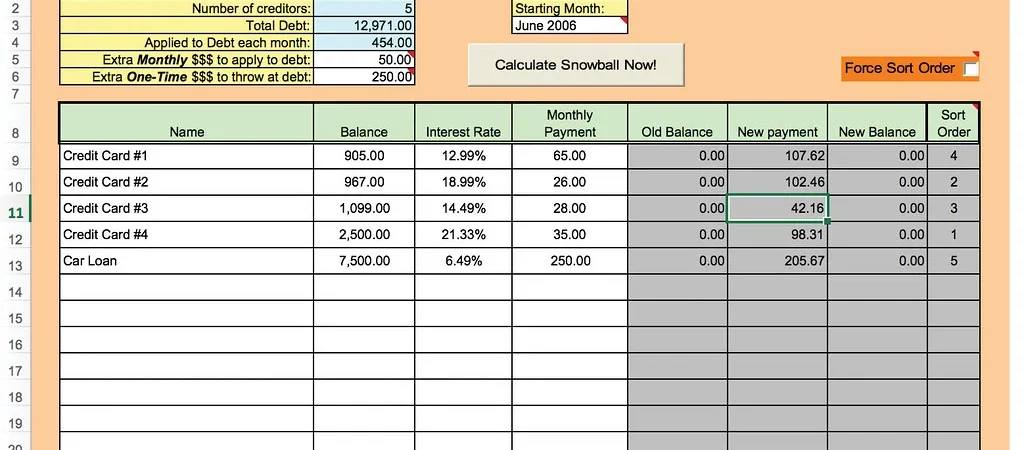
If you’re carrying credit card or loan balances, you’ve probably heard about two popular payoff strategies: the debt avalanche and the debt snowball. Both work — you’ll eliminate debt either way — but they save money and feel very differently along the way. The right choice isn’t about which method is “best.” It’s about which one you’ll actually stick with until the balance hits zero.
How the Debt Snowball Works
The snowball method, popularized by personal finance circles, has you list every debt from smallest balance to largest, ignoring interest rates. You make minimum payments on everything, then throw every extra dollar at the smallest balance until it’s gone. Once that debt is paid off, you roll that payment onto the next-smallest balance — hence “snowball.”
The appeal is momentum. Knocking out a small debt fast feels great, and that psychological win keeps many people motivated months (or years) longer than they otherwise would be. As Wells Fargo explains, the snowball is really about quick wins and staying motivated.
How the Debt Avalanche Works
The avalanche method flips the priority: you list debts from highest interest rate to lowest, regardless of balance. You make minimum payments everywhere, then put every extra dollar toward the highest-APR debt first. Once it’s gone, you move to the next-highest rate.
The payoff is mathematical. By attacking the most expensive debt first, the avalanche minimizes the total interest you pay, so you get out of debt faster and spend less overall. Fidelity notes that the snowball doesn’t save as much on interest because it doesn’t tackle higher-rate balances as quickly.
Snowball vs. Avalanche: The Real Differences
- Total interest paid: Avalanche wins, usually by a meaningful amount on larger balances.
- Time to finish: Avalanche is typically faster overall, all else equal.
- Early motivation: Snowball wins — you see a paid-off debt sooner.
- Complexity: Equal; both are simple lists and a payment order.
- Best fit: Snowball for people who need motivation; avalanche for people who want to minimize cost and can stay disciplined.
A Quick Example
Imagine three debts: $500 at 22% APR, $4,000 at 18%, and $9,000 at 12%. The snowball pays the $500 first (fast win), then the $4,000, then the $9,000. The avalanche pays the $500 first too (it’s also the highest rate), but then targets the $4,000 at 18% before the $9,000. The avalanche saves more interest because it never lets the high-rate balances linger. The snowball would still work — it just costs a bit more in interest in exchange for faster psychological rewards.
What the Experts Say
Financial planner sources generally agree on one thing: the mathematically optimal approach is the avalanche, but the approach you’ll actually follow is the one that wins. Analysis from Experian and Discover reaches the same conclusion: choose the method that keeps you motivated and consistent, because the biggest enemy of debt payoff isn’t interest — it’s giving up.
How to Pick the Right One for You
- Pick the avalanche if you’re disciplined, math-minded, and want to pay the least total interest.
- Pick the snowball if you’ve struggled to stay motivated before or carry several small debts where quick wins will keep you going.
- Not sure? Run the numbers with a payoff calculator; seeing the interest difference can make the decision concrete. Then pick the method you’ll follow.
- Watch for overlap: If your smallest balance also has the highest rate, both methods agree — start there.
Frequently Asked Questions
Does the debt snowball or avalanche save more money?
The avalanche saves more money because it targets the highest interest rates first, reducing total interest paid over time.
Is the debt snowball a myth?
No — it’s a real, effective strategy. It just costs more in interest than the avalanche because it ignores rates in favor of psychological wins.
Can I combine the two methods?
Yes. A common hybrid is to start with the snowball for a quick win, then switch to the avalanche for the larger balances.
The Bottom Line
Both the debt avalanche and debt snowball will get you out of debt — the real question is which one you’ll stay committed to. If you want to spend the least and can stay disciplined, use the avalanche. If you need momentum and small wins to keep going, the snowball is a perfectly valid choice. Whichever you pick, pair it with the basics: a clear budget, an emergency fund so new expenses don’t derail you, and regular progress checks. For more on reducing your interest burden, our guide to paying off credit card debt fast goes deeper into the tactics.
Tools to Keep Your Debt Payoff on Track
The method matters, but so does follow-through. A few simple tools make either strategy easier to stick with:
- A payoff calculator to see total interest and payoff date under each method before you commit.
- A budgeting app to find the extra “avalanche” funds each month — logging spending is where the surplus actually comes from. See our roundup of the best budgeting apps.
- Autopay for the minimum on every debt so you never miss a payment, then manually apply the extra to your target debt.
- A progress tracker — a simple spreadsheet or a debt payoff journal — to record each paid-off balance and keep motivation high.
Whichever method you pick, the winner is consistency: build the extra payment into your budget as a fixed line item, and treat it like a bill you pay to yourself.
Photo: Rosenfeld Media via Openverse (CC BY)